
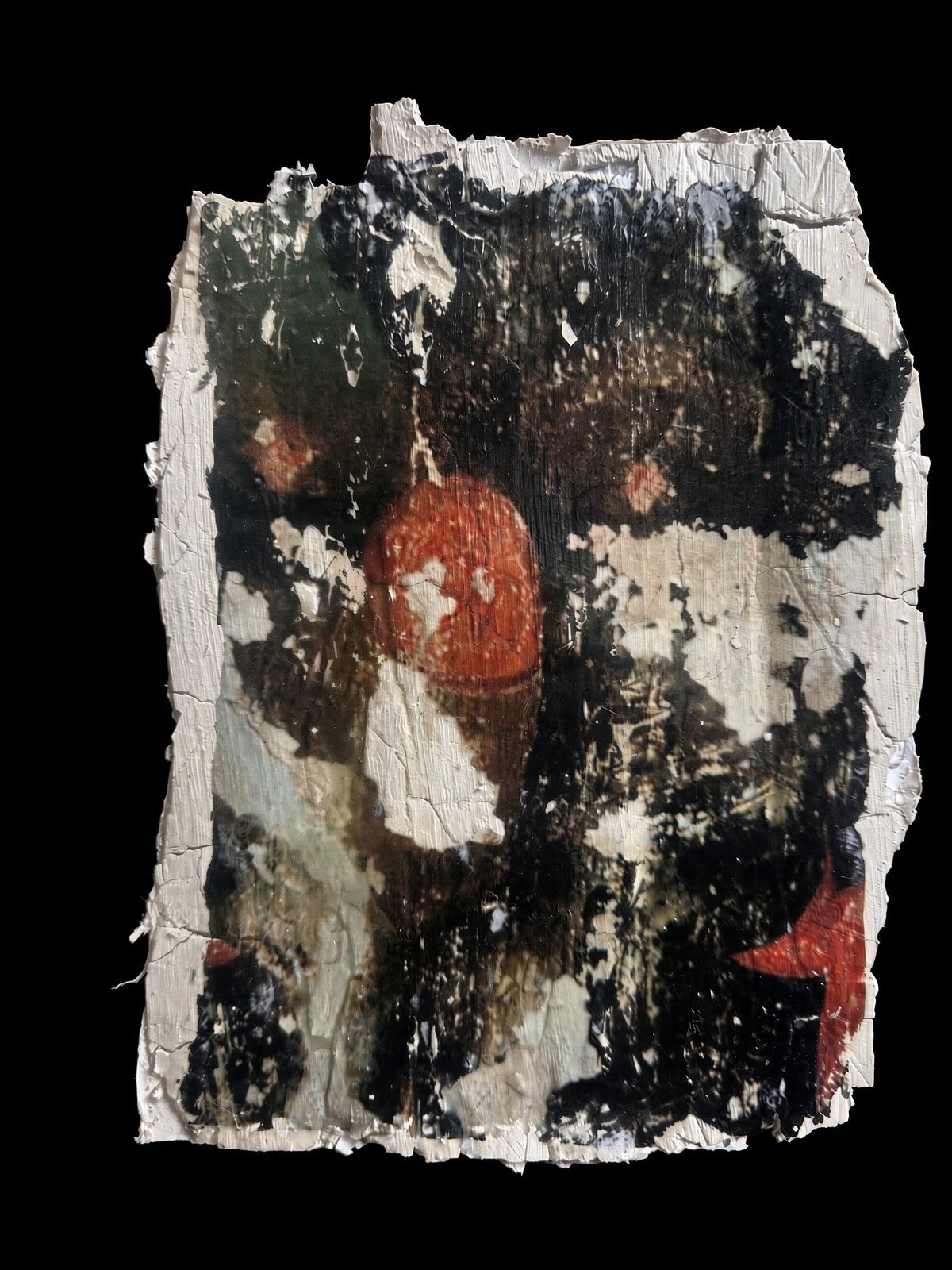
Painted Plaster Fragment with a Red Phallus
Said to be associated with the Abbey of Thelema, Cefalù, with a letter from Kenneth Anger
A fragment of painted plaster said to be associated with the Abbey of Thelema at Cefalù, the house occupied by Aleister Crowley from 1920 until his expulsion from Italy in 1923. A red oval sits on a dark ground, with two smaller red marks above and a red form at the lower right. The edges are broken and irregular. After 1923 the Abbey's murals were whitewashed. In 1955 Kenneth Anger uncovered and filmed surviving decoration. This fragment is accompanied by a personal letter from Anger to a former owner concerning the piece. It is not identified with any picture titled by Crowley, and it is not claimed as a section still visible in published photographs of the house. The association rests on that letter.
By repute, the Abbey of Thelema, Cefalù, Sicily. Private collection, accompanied by a personal letter from Kenneth Anger to the then owner concerning the fragment; thence to the present owner.
Yorke Collection, Warburg Institute, NS74: p. 220, three photographs of paintings in the Chambre des Cauchemars; pp. 221–222, further photographs of paintings at Cefalù. This fragment is not identified among them. NS52: photograph of Kenneth Anger and Dr Alfred Kinsey at Cefalù, 1955.
Surviving painted fragments from the Abbey of Thelema are exceptionally uncommon. Much of the decoration was whitewashed after 1923 and is known chiefly from photographs, or remains in the building. The accompanying letter from Kenneth Anger gives this example its documentary interest. Since December 1990 the villa has been under a Sicilian protection order as of important artistic interest, so painted plaster still on the walls cannot lawfully be removed. That protection is context. For the villa and its protection, see Villa Santa Barbara, Abbazia di Thelema, FAI.
Price on enquiry